
Motivational Stories
Ten Thousand Ways
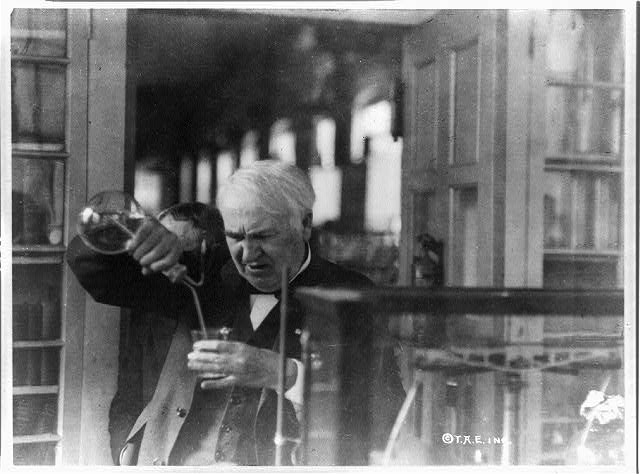
Long before the world knew his name, Thomas Edison was just a boy in Michigan who asked too many questions.
His teachers called him "addled" - slow, difficult, not worth the effort. After only three months of school, they sent him home for good.
His mother refused to accept that verdict. She taught him herself, at the kitchen table, book by book.
By age nine, he had read the entire history of Rome on his own. By twelve, he was running his own small business, selling newspapers and candy on a train.
He set up a tiny chemistry lab in a corner of the train's baggage car, running experiments between stops.
An accident with a stick of phosphorus started a small fire, and the furious conductor threw him and his chemicals off the train at the next station.
It would not be the last time something blew up in his face. It would also not be the last time he simply started again.
As a teenager, he worked as a telegraph operator, tapping out messages through the night, teaching himself electricity one circuit at a time.
He was losing his hearing by then, and it kept getting worse. Most people would have called that the end of a promising path.
Edison called it useful. Without other sounds crowding his thoughts, he said, he could concentrate completely on his work.
By his twenties, he had built a laboratory at Menlo Park, New Jersey - the first of its kind, built for one purpose: to invent, again and again, on purpose.
His most famous challenge came in 1878: a safe, long-lasting electric light for ordinary homes. Gas lamps and candles had lit the world for centuries, and Edison wanted to end that era.
The idea was simple to say and brutal to do - pass electricity through a thin filament until it glowed, without burning out in seconds.
He and his team tried carbonized cotton thread. It glowed - then burned out in minutes.
They tried platinum. Too expensive, and it barely lasted longer.
They tried threads soaked in tar, coconut fiber, fishing line, and, according to the stories, even a hair from a colleague's beard.
Weeks became months. The laboratory notebooks filled with failure after failure, each one carefully written down and dated.
A journalist once asked him, not unkindly, whether it discouraged him to fail so many times chasing one lightbulb.
Edison's answer became one of the most repeated lines in the history of invention: "I have not failed. I've just found ten thousand ways that won't work."
He did not treat failure as the opposite of success. He treated it as a narrowing of the search - one more wrong answer crossed off a very long list.
In October 1879, a filament made from carbonized cotton thread finally glowed steadily inside a sealed glass bulb - and kept glowing, for over thirteen hours straight.
Later, a carbonized bamboo filament would glow for well over a thousand hours. The age of electric light had begun, powered by one man's refusal to call ten thousand failures the end of the story.
Edison went on to hold over a thousand patents in his lifetime - but the lightbulb remains the one people remember, precisely because of how many times it should have made him quit.
His real invention, perhaps, wasn't the filament at all. It was a way of seeing failure - not as a wall, but as one closed door in a long hallway full of them.